
The Contract Is In Your Inbox
The supplier's legal team wrote every clause to protect their organisation.
Before your signature makes it legally binding — do you know what else is needed to protect yours?
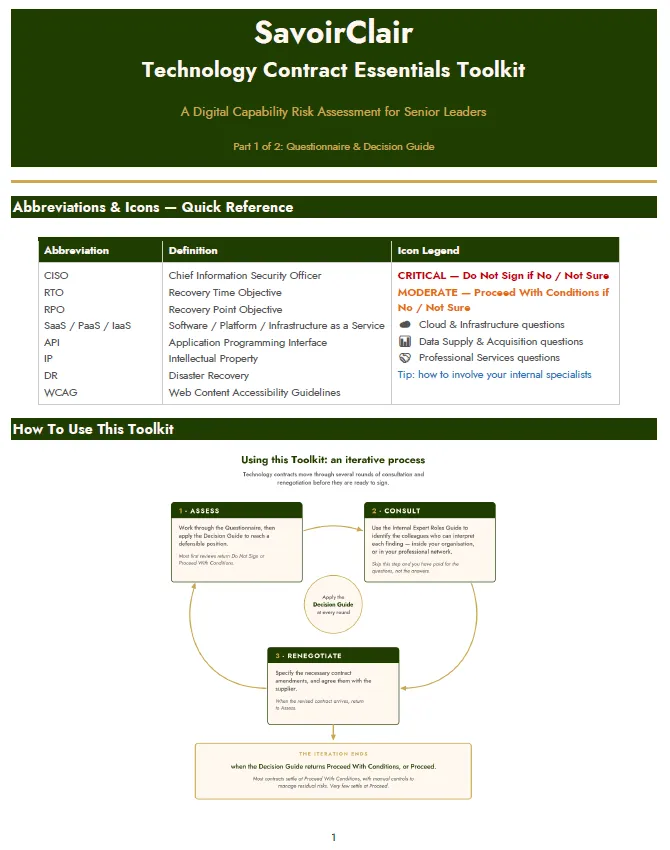
The SavoirClair Technology Contract Essentials Toolkit
A plain-English toolkit that tells you whether your technology contract is safe to sign.
Or start with the free SavoirClair Technology Procurement Red Flag Checklist
Does This Sound Familiar?
The contract is in your Inbox. You're under pressure to sign. Your legal team has reviewed the commercial terms — but has anyone checked whether the contract commits the supplier to deliver what your organisation asked for? Whether the mandatory technology and information management obligations your organisation must meet — cybersecurity certification, privacy breach protection, data sovereignty — are contractually enforceable rather than aspirationally mentioned? Whether the exit provisions protect you if the implementation fails to deliver?
You're not just signing a document. You're committing your organisation to a total investment that typically ends up several times the headline contract value — once implementation, data migration, internal resources, change management and scope additions are factored in. The contract governs supplier accountability for all of it — but may only protect a fraction of that total exposure.

The professional, financial and reputational consequences of a technology contract that doesn't protect your organisation don't stay in the room where you signed it. They follow you. And the stakes have never been higher — technology risks are front-of-mind these days, with cybersecurity and data breaches reported almost daily. The question isn't whether you can afford to review this properly. It's whether you can afford not to.
Where You Are Now
The clock is counting down and you need to review a technology contract with no independent guidance and no structured way to interpret the technical detail. Are the terms skewed in the supplier's favour? Your legal team lacks specialist technology knowledge — so nobody has confirmed whether the contract actually protects your organisation's real interests.
Do you understand what's been promised and what it will take to implement? Can it be delivered in the timeframe, and with what impact on the organisation's resources and other priorities? Will the solution be secure? Will it integrate into your existing technology landscape without breaking something else?
You're making a significant strategic and financial decision with an incomplete picture of the risks and benefits — and you don't want to be responsible for another failed digital transformation that damages your organisation's reputation and your own.
Where This Toolkit Takes You

You've worked through every critical risk dimension systematically and identified the additional clauses required to balance risk-sharing between all parties. You know exactly where the gaps are — and who inside your own organisation needs to review each section. And more importantly, you know what to ask them.
You understand not just whether to sign — but what needs to happen before, during and after to give this implementation the best possible chance of success.
You can confidently document and defend every decision you've made — in front of your board, your investors, your team and your peers.
You're no longer the last line of defence. You're the leader who knows exactly what to look for — and how to address it.
The Cost of Getting This Wrong
The research speaks for itself:

Bain & Company (April 2024) reports that 88% of business transformations fail to achieve their original ambitions — only 12% succeed.
McKinsey and Boston Consulting Group put the digital transformation failure rate at 70%.
The cumulative cost to-date of failed digital initiatives is reported to be around US$2.3 trillion.
The consequences of getting this wrong — cost overruns, failed implementations, locked-in supplier relationships, data breaches, regulatory penalties — don't stay in the room where you signed. They follow you. They follow the team you led. They follow the organisation that trusted you to make the decision.
And for the person who signs, they follow you beyond this role.
The Problem You're Navigating
Technology contracts are one of the few high-stakes decisions organisations routinely leave their senior leaders to navigate without adequate support.
The supplier arrives having prepared for weeks. Their legal team has written every clause — carefully and deliberately — to protect their organisation. You have a response deadline and no methodology for evaluating what you're being asked to sign.
Your legal team can review the commercial terms. What they cannot provide is the technology expertise to tell you whether the cybersecurity obligations are enforceable or merely aspirational. Whether the data ownership clauses quietly transfer organisational assets. Whether the exit provisions are specified or absent. Whether the integration assumptions have been tested.
And that deadline? It's frequently artificial. Price increases threatened if not signed before end of month, end of financial year. In reality, there is almost always room to negotiate — but only if you know what to base your argument on. The errors and omissions your internal experts identify give you exactly that argument. Finding them, briefing them, and acting on their insights takes time — time the supplier's deadline is designed to eliminate.
The gaps in a technology contract don't announce themselves. Absence is invisible until it's expensive.
The Thirty-Second Executive Test
Before you sign, ask yourself:
"If this implementation fails publicly in twelve months — can I demonstrate that I understood the risks, sought appropriate expert input, and made a reasonable and well-documented decision?"
If yes — sign
If no — stop
The Solution
SavoirClair Technology Contract Essentials Toolkit — £97
The plain-English tool that helps you find the questions you need to ask, identify the people you need to consult, and create the documentation to back up a defensible decision — before your signature makes it legally binding.
Fifty "critical" and "moderate" questions across nine risk areas — strategic alignment, commercial structure, delivery acceptance, security and privacy, data ownership, cloud and infrastructure, integration, observability, and exit provisions — with three conditional sub-sections for Cloud, Data Acquisition, and Professional Services scope types.
Not a substitute for legal advice. The independent technology domain perspective that legal teams cannot provide — available before the deal is done, not once the project goes off course.
This Is For You If...
You're a senior leader of a private-sector, public-sector or non-profit organisation — capable, values-driven, experienced — and a technology contract has just landed in your Inbox with a deadline attached.
You don't have the technology domain expertise to evaluate it independently, and there's no one unambiguously on your side at this critical decision point.
You've inherited supplier relationships from a predecessor — already embedded, already leading, already comfortable with a power balance that doesn't serve you or your organisation.
You're the most senior person in the room — and somehow still the least well-informed when the contract arrives.
This Is NOT For You If...
You're looking for legal advice or a substitute for proper legal review of commercial Terms and Conditions.
SavoirClair gives you the technology domain perspective — the dimension most legal teams can't provide.
It works alongside your legal counsel, not in place of them.
How the Toolkit Works
The Toolkit is designed for iterative use. Most contracts move through several rounds of internal consultation and supplier renegotiation before they're ready to sign — and the process is revisited at each iteration. This is not a one-sitting exercise. It is a structured process for the full journey from first review to final decision.
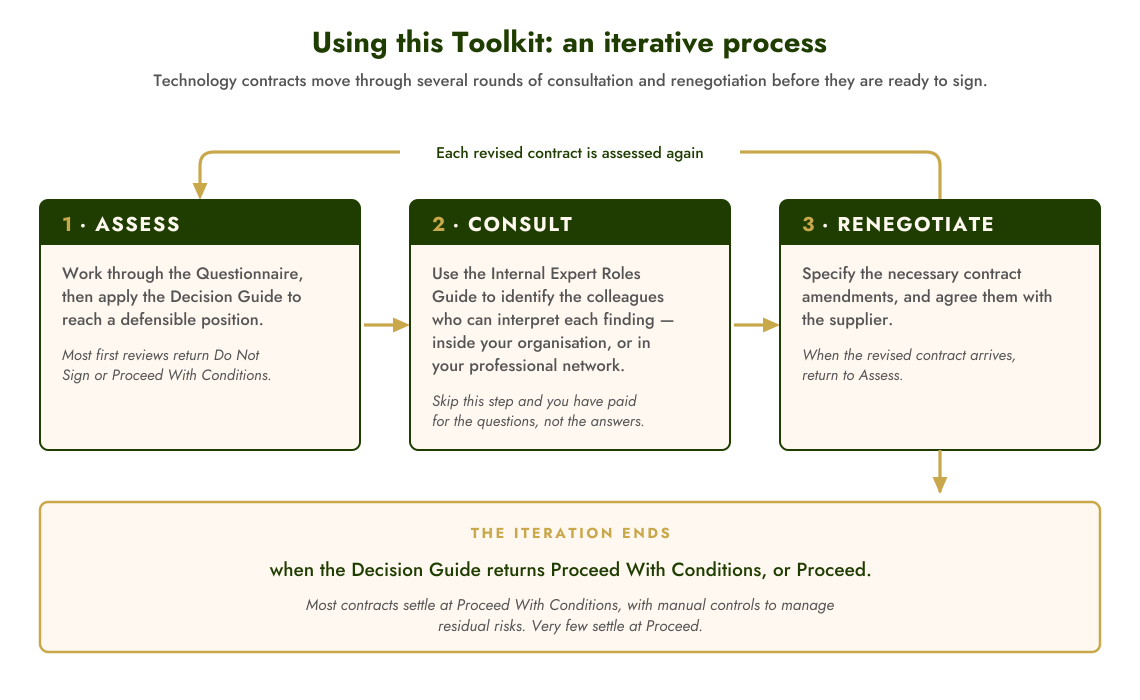
The three activities work together, each revisited as the contract evolves:
Step 1 — Apply the Questionnaire
Work through all fifty plain-English questions after reading the contract. Each question identifies what you need to establish — and points you toward the specialist expertise inside your organisation that can answer it. Each question is anchored in a specific risk area and rated Critical or Moderate.
Use the Decision Guide to document a clear, defensible position: Do Not Sign, Proceed With Conditions, or Proceed — with the rules and rationale clearly defined so your decision is consistent and defensible to your board, your team, or anyone who asks.
Step 2 — Consult the Experts
Use the Internal Expert Roles Guide to identify exactly who inside your organisation should review specific sections — your enterprise architects, solution architects, information management specialists, security professionals, data leaders, GRC colleagues. You may be tempted to skip this step when you're under pressure to sign. But without the consultation, you've paid for the questions but not for the answers.
Step 3 — Renegotiate
Use your experts' input to specify the changes required to protect your organisation. Work with the supplier to agree them. When the revised contract arrives, return to Step 1 and work through again to confirm all concerns have been addressed.
The process ends when the Decision Guide returns Proceed With Conditions or Proceed. Most contracts settle at Proceed With Conditions. Very few settle at Proceed.
What's Included
Questionnaire
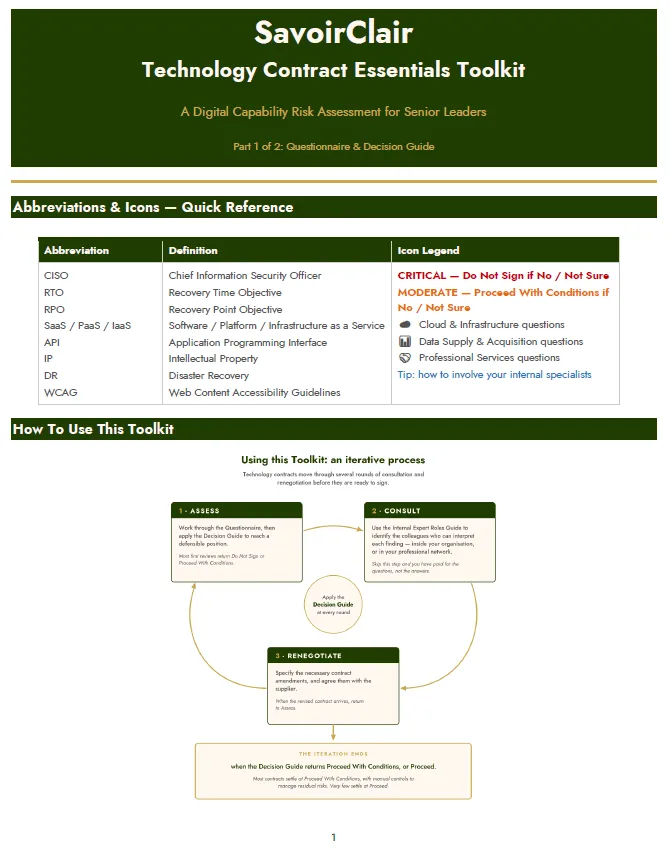
Fifty plain-English questions across nine sections covering every critical contract risk dimension — with conditional sub-sections for Cloud, Data Acquisition, and Professional Services engagements.
Each question identifies what you need to establish and points you toward the specialist expertise inside your organisation that can answer it.
Decision Guide
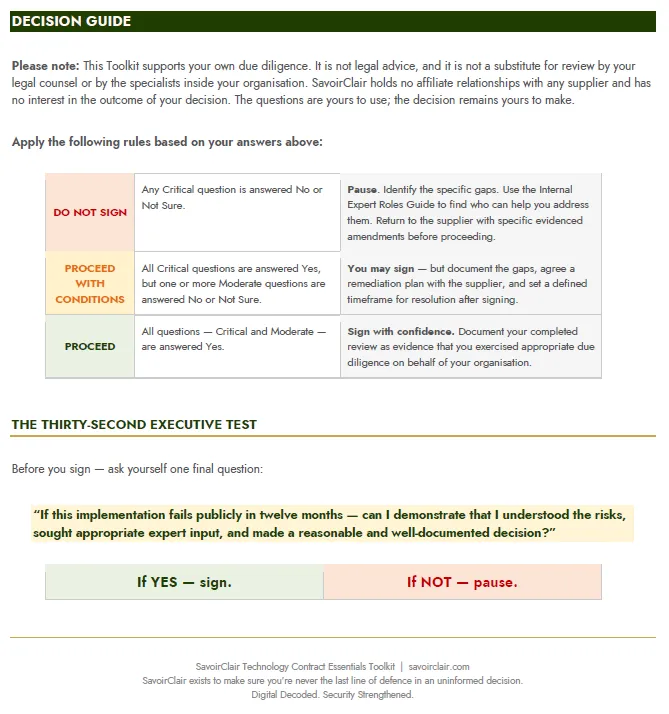
A structured framework that brings you to a clear, defensible position: Do Not Sign, Proceed With Conditions, or Proceed. With rules, rationale, and a defensibility check — the question that confirms you can stand behind your decision in front of your board.
Internal Expert Roles Guide
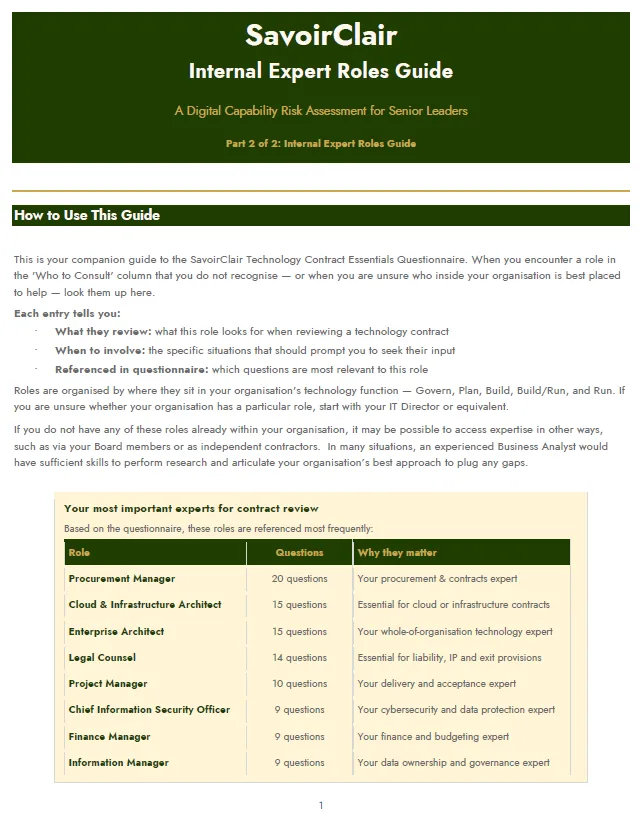
Identifies exactly who to consult before signing, either inside your organisation or from your professional network — so the specialist expertise that's already there is engaged at the right moment, not called in after the damage is done.
Working through the Toolkit properly takes time — often across several days, spread through the review period rather than done in one sitting. The contract it covers may bind your organisation for five years, and sometimes considerably longer.
What Early Customers Are Saying
"As a governance professional, I have found that the SavoirClair Technology Contract Essentials Toolkit provides a disciplined and practical framework for assessing the technical, commercial and contractual risks embedded in technology supplier agreements.
"Its structured questions are designed to assist leaders, including nontechnical leaders, to identify issues around service performance, data, security, supplier dependencies, liability, compliance and exit obligations that could otherwise be missed during procurement.
"Importantly, it translates technical and legal considerations into commercially meaningful and simple questions that leaders can use to challenge supplier terms and determine where specialist advice may be required.
"The result is a practical, repeatable approach that strengthens technology procurement decisions without requiring leaders to be technology specialists."
— Governance, Risk & Compliance specialist, beta tester
"As a solution architect, I reviewed the Toolkit and found it provides comprehensive coverage of the essential considerations required for successful technology procurement.
"The questionnaire plays an essential role in surfacing fundamental risks early, strengthening contractual clarity, and supporting cost‑effective decision‑making. The framework ensures IT initiatives commence with a solid start and lead to a successful delivery."
— Digital Solutions professional, beta tester
"£97 feels like too good a deal for the corporate market."
— Senior leader, state government entity, beta tester
"A product that MANY organisations could benefit from. In the state government alone, this process is so painful. And as a taxpayer, I just hold my head in my hands over the wasted millions."
— Unsolicited reaction from an early reader on supplier contract gaps
A third beta tester said they would pay AU$1,000 for the Technology Contract Essentials Toolkit, based on the substance of the framework.
Your Guarantee
SavoirClair exists to make sure you're never the last line of defence in an uninformed decision. The Toolkit is built to leave you clearer and more confident than you were before you started. If it doesn't, we'll refund you in full — no questions asked, and no need to explain.
Please refer to our Refunds & Returns page for more information.
Why Independence Matters
SavoirClair has no affiliate relationships. No commission arrangements. No referral fees or non-financial benefits from any supplier, platform, or service provider.
The Toolkit gives you genuinely independent guidance.
Independence is one of five brand values that SavoirClair lives by. Visit the Our Values page to find the others.
About SavoirClair
I'm Lorraine Pestell, founder of SavoirClair. For nearly three decades I worked as a digital strategist across multiple geographies and industry sectors — watching capable, intelligent leaders navigate complex digital transformation initiatives they didn't fully understand, under deadline pressure that was frequently artificial, with no independent guidance.
And the stakes have never been higher — technology risks are front-of-mind these days, with cybersecurity and data breaches reported almost daily. SavoirClair is the bridge I would have given anything to share with these leaders — before the commitment, not after.

Strategy made accessible.
Transformation made achievable.
Expertise made human.
The Decision
The contract has arrived. The supplier is on the phone.
Questionnaire
Decision Guide
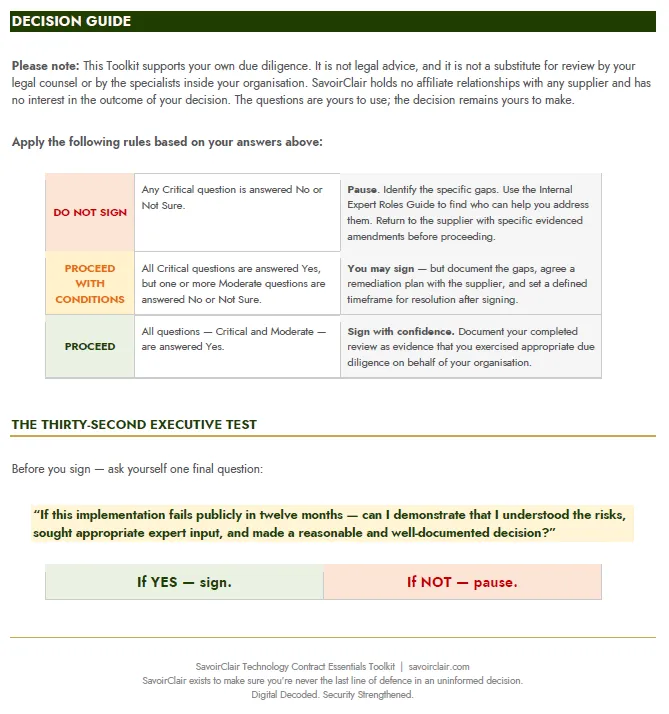
Internal Expert Roles Guide
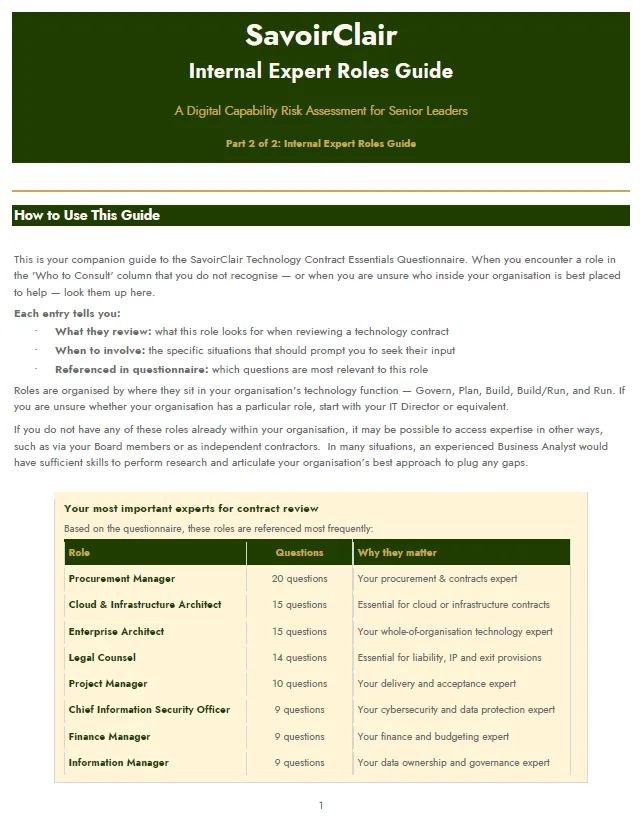
Work through the Toolkit at your own pace. It may require several rounds of negotiation with the supplier before you and your subject-matter experts are ready to sign.
Don't sign until you know what's still required to protect your organisation.
A Note To Digital, Data & Technology Professionals
If you work in technology, architecture, information management and analytics, security, governance, or any specialist role adjacent to these disciplines — you may have arrived here because there's a senior leader in your organisation who needs this.
If there's someone in your network or professional community navigating a technology contract decision right now — this is the resource they need before they sign. The Toolkit is designed to be forwarded, so please share the link to this page or contact us at [email protected] with their details.
SavoirClair. In your corner, not in your chair.
© 2026 | SavoirClair™

